From December 8 to 12, IEEE GLOBECOM 2025, one of the flagship conferences of the IEEE Communications Society, was successfully held. During the conference, the IEEE Communications Society Signal Processing and Computingfor Communications (SPCC) Technical Committee held an online award ceremony. The paper "Enhanced Projection-Type Receivers in Uplink ISAC Systems," authored by Zhiyuan Yu, a graduate student who enrolled in 2023 at the School of Information Science and Engineering, Southeast University, Associate Professor Hong Ren, Professor Cunhua Pan, Academician Jiangzhou Wang, and others, received the Best Paper Award from the IEEE Communications Society Signal Processing and Computing for Communications Technical Committee. Professor Gui Zhou of Huazhong University of Science and Technology is also a co-author of the paper.
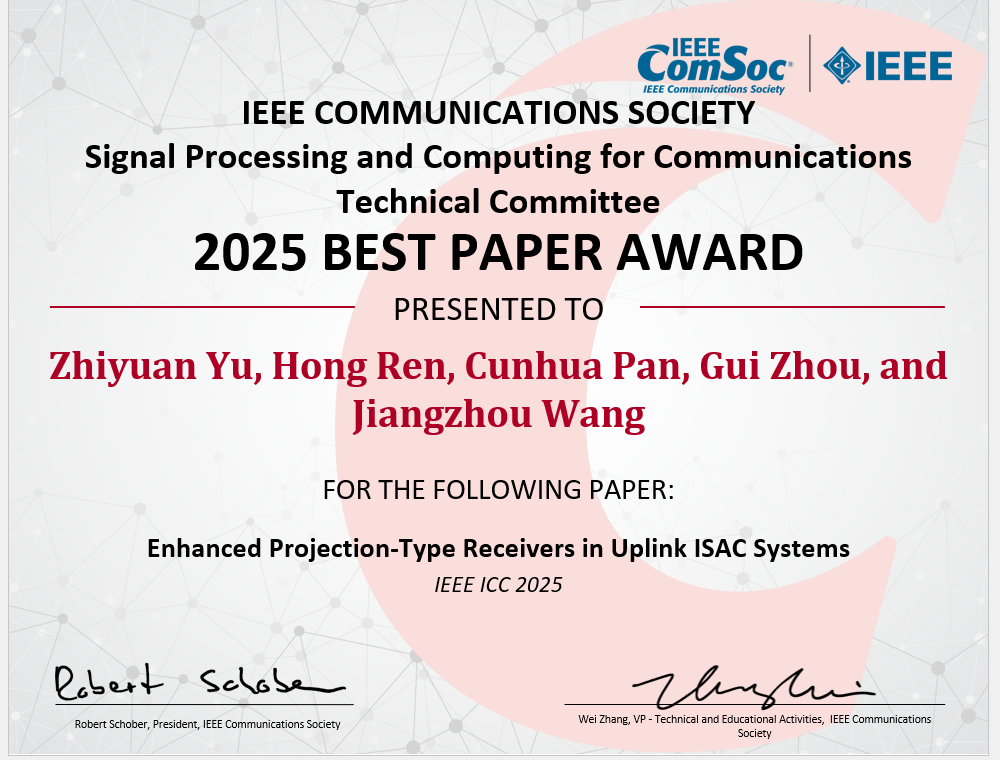
Established in 2020, the IEEE Communications SocietySPCC Technical Committee Best Paper Award selects one paper each year from all papers published in the proceedings of the Society's two flagship conferences, ICC and GLOBECOM, in recognition of outstanding contributions to communication signal processing.
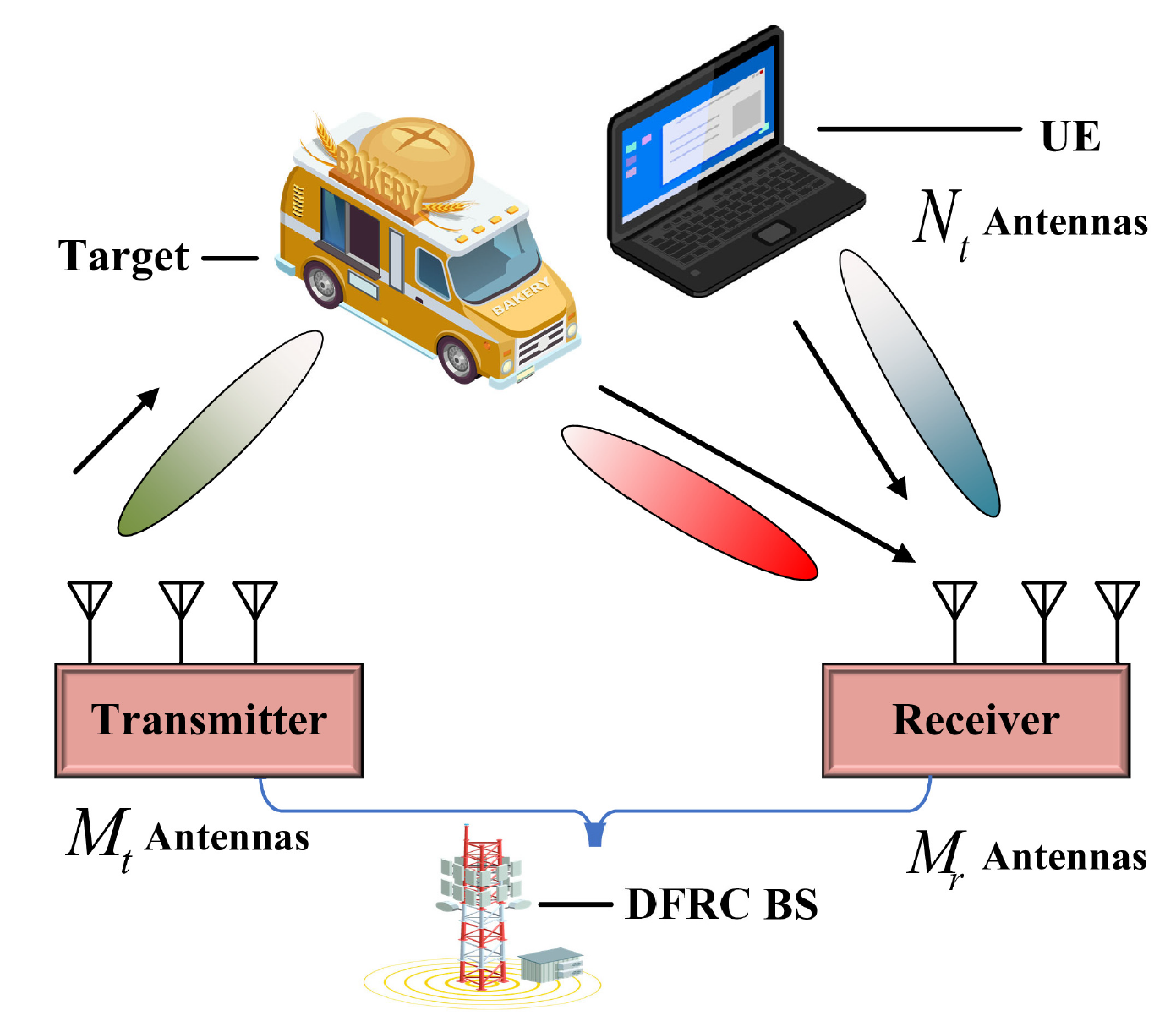
Future 6G networks must simultaneously support high uplink data rates and high sensing accuracy. This paper focuses on a scenario in which uplink communications and sensing operate concurrently in the same frequency band, and aims to address mutual interference between communication and sensing signals through efficient receiver design. Theoretical analysis shows that projection-type receivers can attain maximum-likelihood detection performance, thereby achieving theoretically optimal sensing and signal detection. Building on this result, the study provides an in-depth analysis of the tradeoff between signal-to-noise ratio and condition number in uplink ISAC receiver design. With practical detection performance as the primary consideration, it further improves the receiver architecture and proposes low-complexity detection algorithms to overcome the dual challenges of an underdetermined observation matrix and high computational complexity.
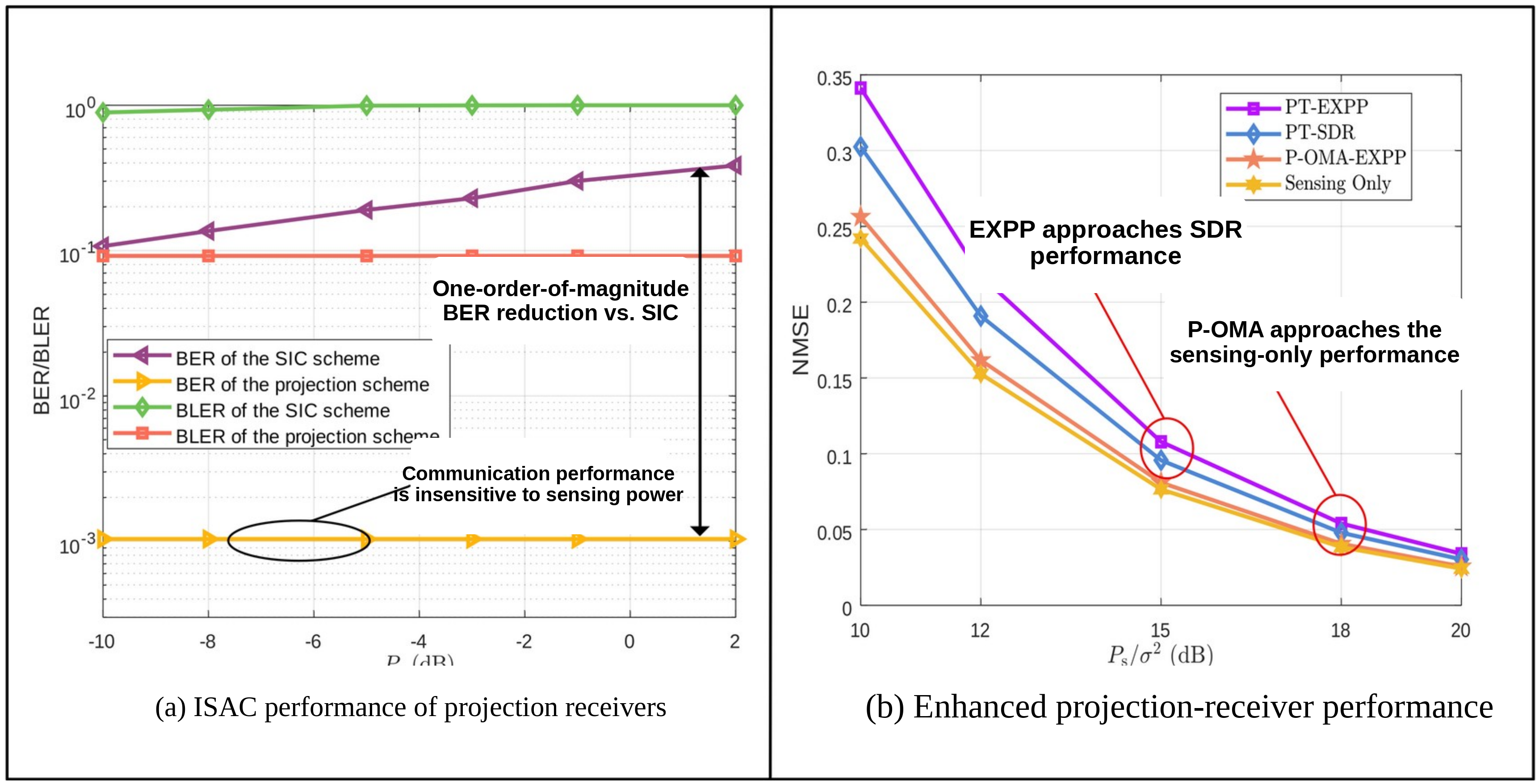
Simulation results show that, compared with conventional successive interference cancellation, projection-type receivers reduce both the bit error rate and the normalized mean-square error (NMSE) of sensing by a full order of magnitude. Building on this foundation, the two proposed enhanced designs further unlock the performance potential of projection-type receivers, simultaneously reducing the bit error rate and NMSE and providing strong evidence for the technical feasibility of uplink ISAC.