Recently, IEEE GLOBECOM 2025, the flagship conference of the Institute of Electrical and Electronics Engineers (IEEE), was successfully held. During the conference, the IEEE Communications Society (ComSoc) hosted its awards ceremony. A paper titled “Active RIS versus passive RIS: Which is superior with the same power budget?” authored by Professor Cunhua Pan and Associate Professor Hong Ren from the School of Information Science and Engineering, Southeast University, and published in the prestigious communications journal IEEE Communications Letters, received the 2025 IEEE Heinrich Hertz Award for Best Communications Letters. It was the only paper to win this award in 2025.
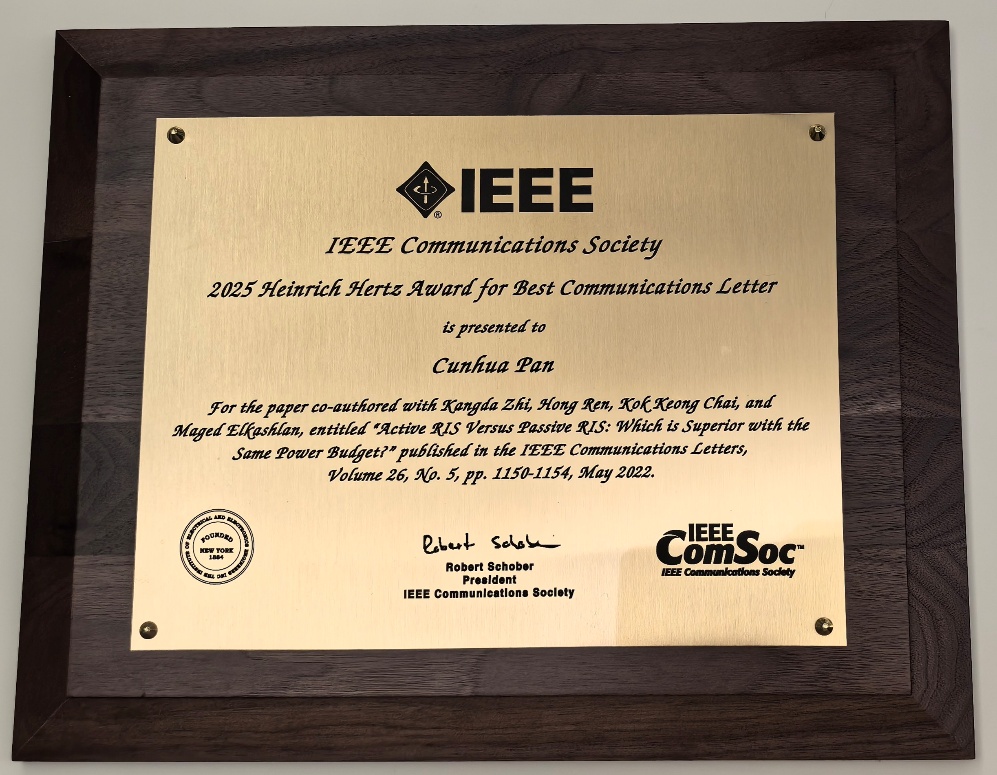
Named after the renowned physicist Heinrich Hertz, who first experimentally verified the existence of electromagnetic waves, this award recognizes the best paper published over the past three years in IEEE Wireless Communications Letters, IEEE Communications Letters, and IEEE Networking Letters, based on criteria including paper quality, originality, and impact. It is one of the most influential international academic awards in the field of communications. The first author of the paper is Kangda Zhi, a Ph.D. graduate of Queen Mary University of London (a doctoral student of Professor Cunhua Pan, now a Marie Curie Fellow at the Technical University of Berlin). The corresponding author is Professor Cunhua Pan, and co-authors include Associate Professor Hong Ren, among others.
Reconfigurable Intelligent Surface (RIS) technology is regarded as one of the key solutions for enabling low-cost, low-power customized wireless transmission environments in future 6G networks. It has demonstrated significant application potential in several critical areas, including improving system energy efficiency and enhancing network coverage. Over the past five years, with the continuous exploration and trials of RIS industrialization for indoor, outdoor, and weak-coverage scenarios by three major telecom operators, universities, and equipment vendors of China, the path toward engineering deployment has been accelerating and becoming clearer. Driven collaboratively by organizations such as the RIS Task Group of the IMT-2030 (6G) Promotion Group and the China Institute of Communications RIS Technical Committee, established on December 6, 2025, RIS is expected to be gradually incorporated into the 6G standards framework as a key technology.
To address the performance limitations of passive RIS caused by multiplicative path loss, the novel active RIS has been proposed by the academic community as a potential technological evolution. The award-winning paper is one of the early works that theoretically analyzed and demonstrated the performance gains of active RIS. Considering that the new active RIS, equipped with active amplifiers, requires additional energy consumption, the paper first established a fair comparison framework between active and passive RIS under the same total system power budget. It characterized the optimal base station–active RIS power splitting ratio under a given total power budget impression, and theoretically revealed the principles for setting the power splitting ratio under different application scenarios with respect to key system parameters. Subsequently, through rigorous theoretical analysis under the same total system power budget, the paper proved for the first time the significant spectral efficiency and energy efficiency gains of the novel active RIS with active amplifiers over passive RIS, along with the theoretical conditions for achieving these gains. The analytical conclusions confirmed the enormous application potential of active RIS in 6G communication systems and clarified the evolution path of RIS toward an active technology architecture.
|
|
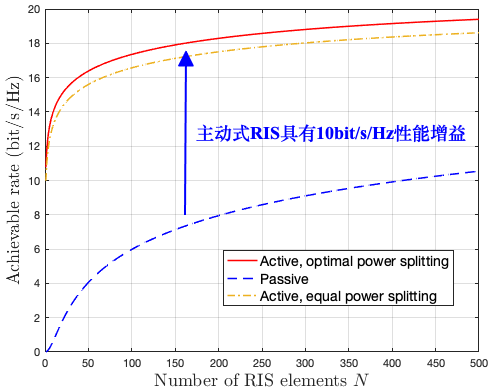
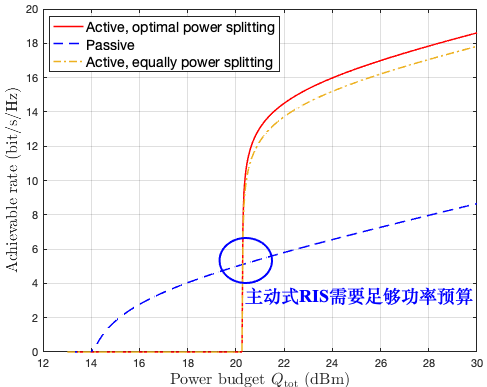
Simulation results further supported the theoretical conclusions: under the same total system power budget framework, active RIS can achieve a spectral efficiency improvement of 10 bit/s/Hz compared to passive RIS. Meanwhile, the results elucidated the applicable scenarios and application potential of both passive RIS and active RIS across different power budget ranges.
This research provides quantifiable criteria and theoretical support for the transition of active RIS from theory to engineering application. Currently, 3GPP has standardized the Network-Controlled Repeater (NCR) in Release 18, with a certain scale of deployment already achieved, offering a practical pathway for active RIS to be implemented as an enhanced version of NCR. As an industrialization pilot, Hubei Mobile recently initiated a tender procurement of 300 RIS units to address coverage issues in small and medium-sized indoor enclosed scenarios and low-rise residential areas within the province. Among these, the NCR with RIS phased array features near-end and far-end equipment responsible for signal reception and transmission respectively, enabling semi-static beam adjustment while maintaining moderate robustness against user mobility, without requiring modifications to the 5G air interface protocol. This reflects a growing industry consensus on the deployment path of active RIS as a relay enhancement solution, which is expected to play a key enabling role in future 6G networks.
Since its publication in May 2022, the paper has been cited 584 times on Google Scholar, making it the most cited paper among over 4,000 papers published in IEEE Wireless Communications Letters, IEEE Communications Letters, and IEEE Networking Letters over the past three years. The paper has been downloaded over 10,000 times and has been selected as an ESI Hot Paper (top 0.1%) and a Highly Cited Paper (top 1%).
Paper link:
https://ieeexplore.ieee.org/abstract/document/9734027