Recently, the research team led by Young Chair Professor Ji Chen, Chair Professor Zaichen Zhang, and Academician Xiaohu You of the Chinese Academy of Sciences at Southeast University made a breakthrough in the field of optical wireless communications. The team developed a new topology optimization algorithm for micro- and nanostructures and designed a freeform metasurface beamformer capable of efficiently steering optical beams with an efficiency of over 80% across an ultra-wide angular range of ±80°. The team also demonstrated, for the first time internationally, a full-duplex high-definition video call system based on optical metasurfaces.
The related research, titled “Shape-optimized metasurface beamformer for high-efficiency full-duplex optical wireless communications across an ultra-wide field-of-view,” has been published online in Nature Communications (2026). DOI: 10.1038/s41467-026-70665-z. Article link: https://www.nature.com/articles/s41467-026-70665-z

Background: The Sharp Efficiency Drop in Wide-Angle Beam Steering
Beam steering is a key technology in optical wireless communications, as it establishes long-distance, high-speed data transmission links between transmitters and receivers. Wide-angle beam steering can significantly expand the communication coverage of such systems. In 2024, the team integrated a fiber array with a wide-angle metalens to realize a high-speed parallel optical wireless communication system with wide-angle coverage of ±60° and a transmission capacity of 28.8 Tbps (Ji Chen et al., Nature Communications, 15, 7744, 2024. DOI: 10.1038/s41467-024-52056-4). This work overcame the limitations of conventional optical wireless communication systems based on galvanometers and liquid-crystal spatial light modulators, particularly in terms of optical signal coverage and system communication capacity.
However, in further investigations, the researchers found that although conventional-shaped metasurface structures can meet the phase modulation requirements for wide-angle beam steering, the energy efficiency of the deflected beam decreases sharply as the steering angle increases. This issue seriously affects the communication quality for users located at large angular positions. Therefore, solving the efficiency degradation problem in wide-angle beam steering is of great importance for improving the performance of metasurface-based optical wireless communication systems.
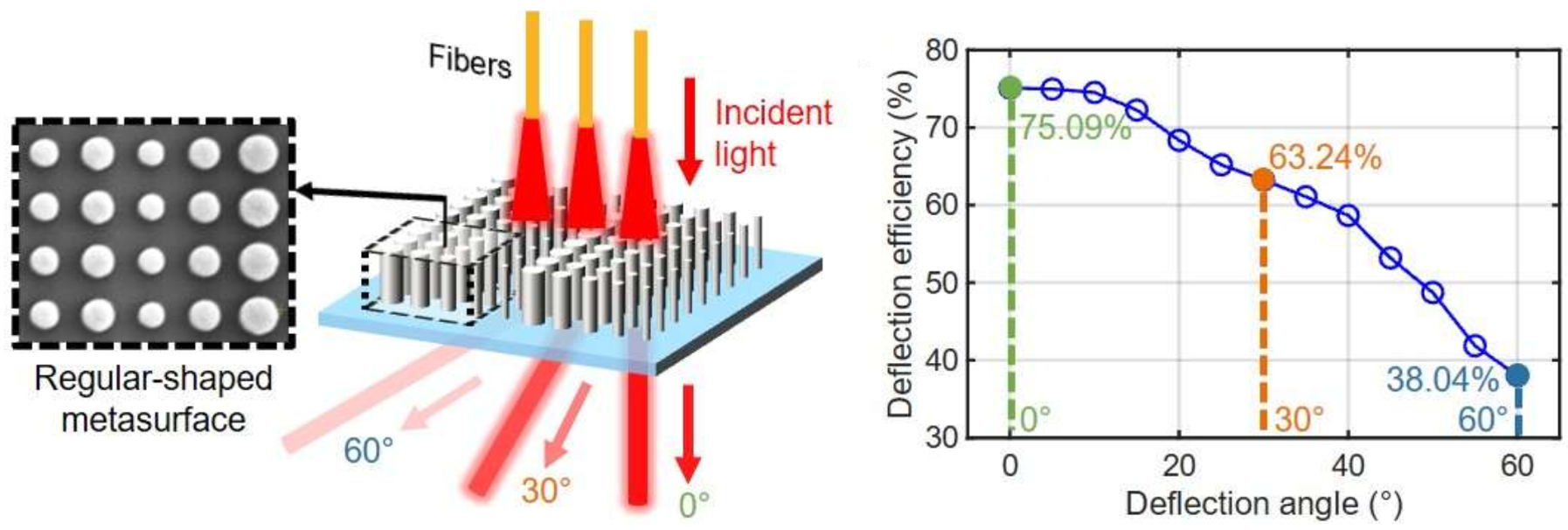
Figure 1. Sharp efficiency drop in wide-angle beam manipulation using conventional-shaped metasurfaces.
Freeform Metasurfaces for High-Efficiency Beam Steering
To address this challenge, the research team proposed the use of freeform metasurfaces with a larger parameter optimization space to improve the efficiency of wide-angle beam steering. The team developed a new metasurface shape optimization scheme based on a two-stage progressive strategy of “initial configuration followed by refinement.” They also established constraints linking structural design parameters with fabrication feasibility, thereby avoiding difficult-to-fabricate features such as tiny holes and sharp edges.
The optimized structures for different steering angles all exhibit continuous and smooth boundaries as well as clearly defined feature sizes. The team experimentally tested the bidirectional steering efficiency of the optimized structures. The results show that the efficiency of beam steering at 80° can reach approximately 80% in both directions, providing a solid experimental foundation for the subsequent realization of a high-efficiency full-duplex video call system.
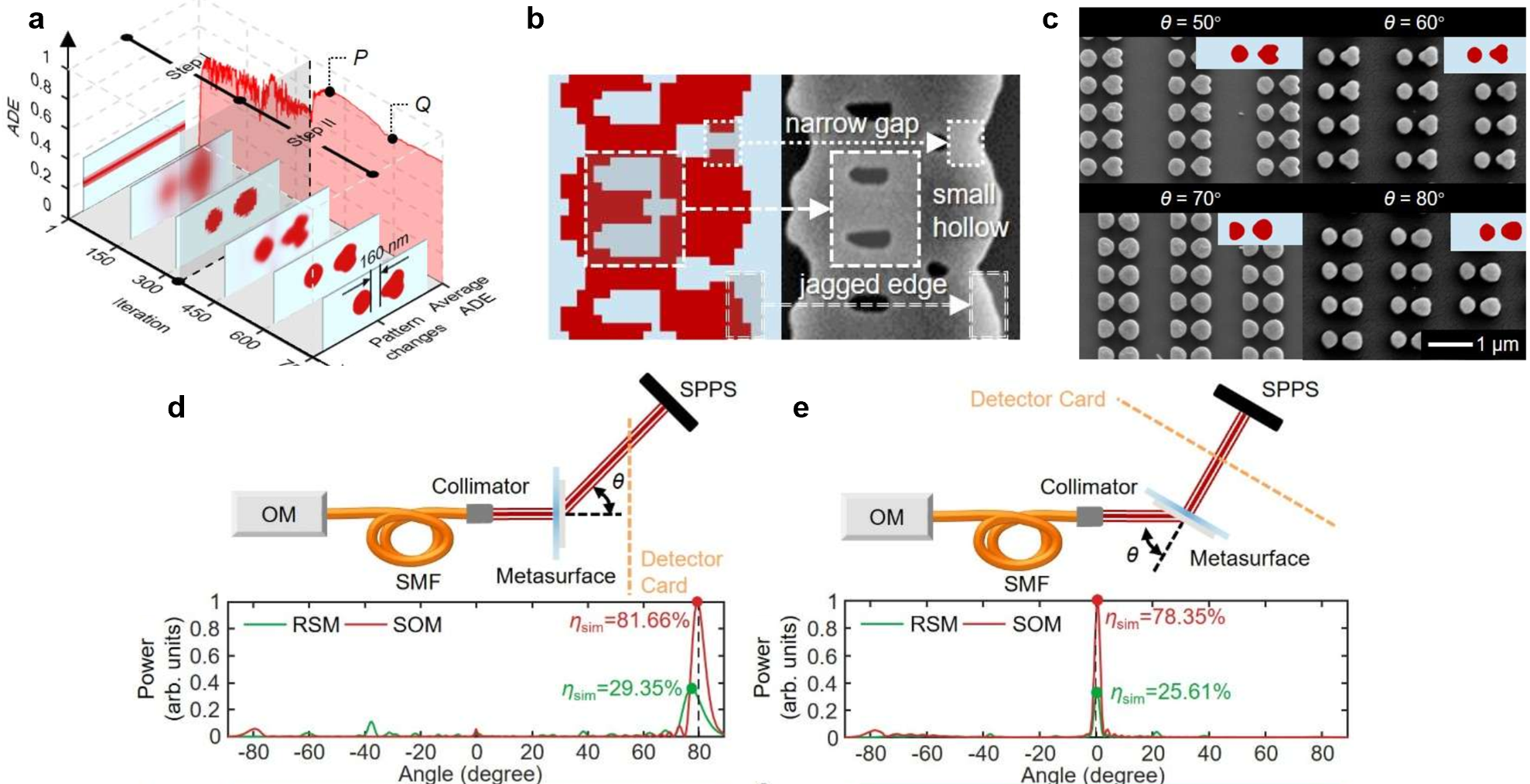
Figure 2. (a) Two-stage progressive shape optimization strategy; (b) difficult-to-fabricate structural features caused by conventional topology optimization; (c) smooth freeform structures optimized for different steering angles; (d, e) bidirectional beam steering efficiency measurements.
Full-Duplex, Low-Latency High-Definition Video Call System
The research team demonstrated the world’s first full-duplex high-definition video call system based on metasurfaces. The system adopts a hybrid optical–radio frequency architecture, in which mobile terminals connect to base stations through radio frequency signals, while the base stations and the core network are connected through high-efficiency wide-angle optical links.
This architecture effectively addresses the challenge of limited terminal mobility in all-optical metasurface-based wireless communication systems, where optical-frequency metasurfaces are difficult to dynamically tune. The researchers compared the video call performance of wide-angle optical links modulated by conventional-shaped metasurfaces and shape-optimized metasurfaces. The results show that the high-efficiency beams generated by the shape-optimized metasurfaces enable significantly lower latency and smoother video transmission.
Notably, this high-performance system was verified not only in indoor short-distance communication scenarios of 2 meters, but also in outdoor long-distance communication scenarios of 200 meters.
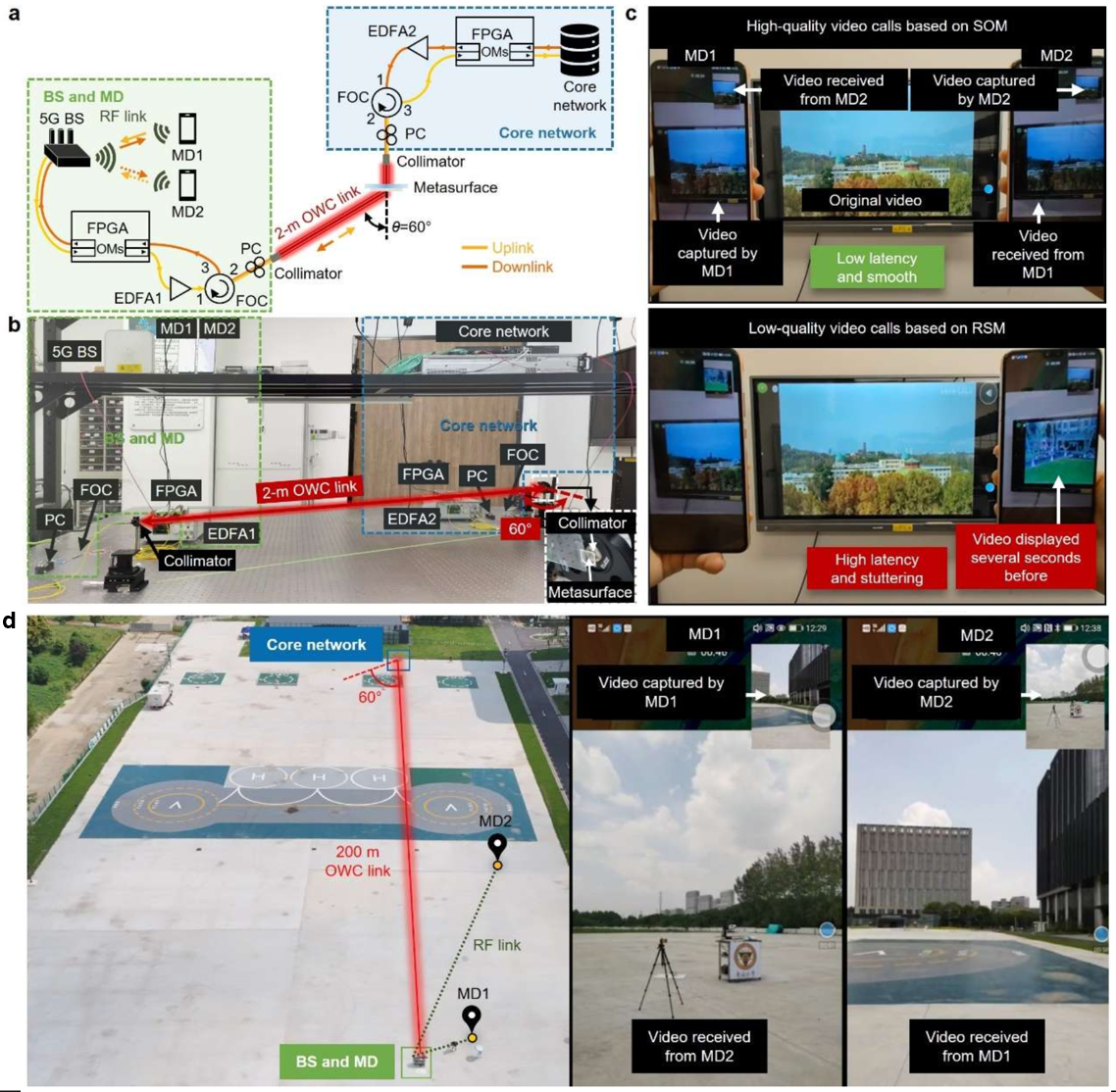
Figure 3. Metasurface-based full-duplex high-definition video call system: (a) system architecture and (b) indoor experimental setup; (c) comparison of video call performance between shape-optimized metasurfaces and conventional-shaped metasurfaces; (d) outdoor long-distance optical link video call experiment.
Furthermore, the research team proposed an array-based layout strategy. By azimuthally rotating and stitching together high-efficiency structures optimized for different angles, and by combining them with a fiber-array light source, the system can achieve high-efficiency omnidirectional beam coverage in space. This strategy greatly enhances both the communication coverage and communication capacity of the system.
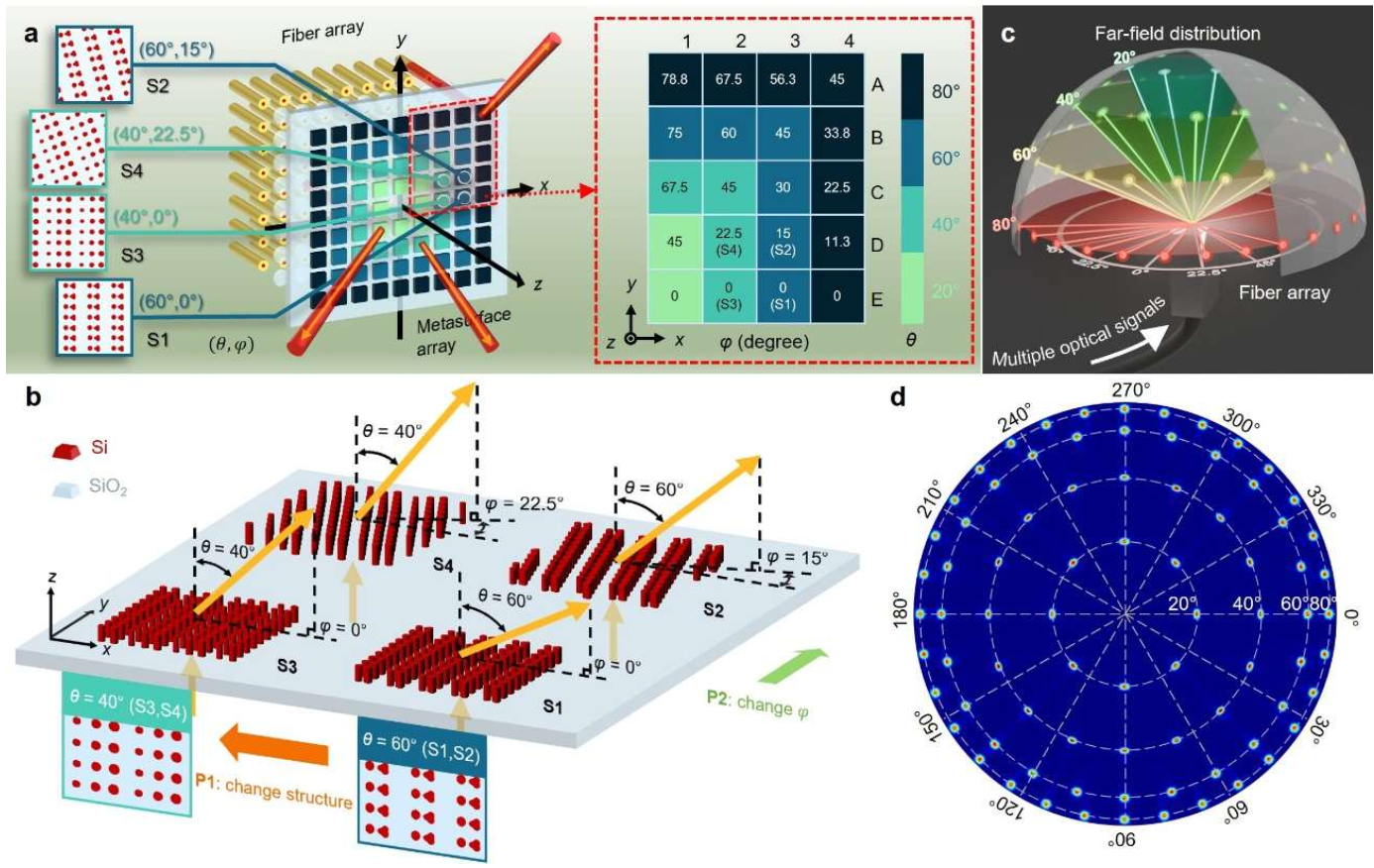
Figure 4. Array-based structural design for high-efficiency omnidirectional spatial beam coverage.
Summary and Outlook
This research represents another important advance by the team in developing practical wireless communication systems based on optical metasurfaces. Compared with the team’s previous work, this study places greater emphasis on system-level performance in real communication processes. The proposed metasurface beamforming device not only delivers excellent performance but also features an ultra-compact footprint, making it suitable for integration into highly mobile platforms such as robots and unmanned aerial vehicles. The technology provides strong support for the development of emerging applications such as the industrial Internet of Things and low-altitude wireless private networks.
The School of Information Science and Engineering at Southeast University and Purple Mountain Laboratories are the first and second completing institutions of this work, respectively. Zhongyi Yuan, a Ph.D. student at the School of Information Science and Engineering, Southeast University, and Professor Ji Chen are co-first authors of the paper. Professor Ji Chen, Professor Zaichen Zhang, and Academician Xiaohu You are co-corresponding authors. Associate Professor Bingcheng Zhu from the School of Information Science and Engineering at Southeast University and Engineer Yin Wang from Purple Mountain Laboratories also made important contributions to this work.
This research was supported by the National Natural Science Foundation of China, the Natural Science Foundation of Jiangsu Province, and other funding programs.